Off the Beaten Freight Lane: How Vietnam's Secondary Logistics Corridors Are Outperforming the Obvious Routes
Conventional wisdom in Vietnam freight routing tends to converge on the same two answers: ship through Ho Chi Minh City for the south, Hanoi or Hai Phong for the north. These are logical defaults. They are major commercial hubs with established carrier relationships, deep customs expertise, and high freight volumes that generally translate to competitive rates. But defaults have a cost. When every major importer funnels cargo through the same chokepoints, congestion accumulates, lead times stretch, and the competitive advantage of those hubs erodes.
A growing number of US importers—particularly those with more complex sourcing footprints or time-sensitive product categories—are quietly discovering that Vietnam's secondary freight infrastructure offers something the primary hubs increasingly cannot: predictability.
Understanding the Geography of Vietnam's Freight Network
Vietnam's industrial geography is more distributed than many foreign buyers realize. While Ho Chi Minh City and its surrounding provinces remain the country's manufacturing heartland, significant production capacity has migrated northward and into the central coastal regions over the past decade. Electronics assembly has concentrated in the north, around Hanoi, Bac Ninh, and Thai Nguyen. Textile and footwear production has spread across provinces like Nghe An, Ha Tinh, and Binh Dinh. Each of these clusters generates freight that must eventually reach an international gateway—and the path to that gateway is not always the one printed on the standard routing guide.
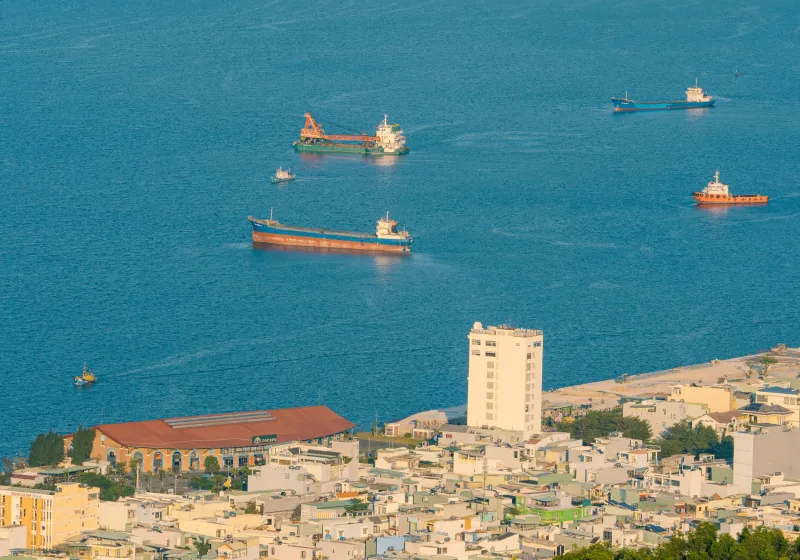
Vietnam's coastline spans more than 3,000 kilometers, and the country has invested substantially in port infrastructure outside its two primary gateways. Ports including Da Nang, Quy Nhon, and Cai Mep—the latter a deep-water facility in Ba Ria-Vung Tau province—each offer distinct advantages depending on origin location, cargo type, and destination market.
Cai Mep: The Deep-Water Alternative That Changes the Ocean Freight Equation
Among Vietnam's secondary port options, Cai Mep International Terminal deserves particular attention from US importers. Located approximately 70 kilometers southeast of Ho Chi Minh City, Cai Mep is one of the few Vietnamese ports capable of handling ultra-large container vessels—the same class of ships that call directly at US West Coast ports without intermediate transhipment.
This matters because transhipment is one of the most underappreciated sources of delay and cost in Vietnam-to-US ocean freight. When cargo is moved through an intermediate hub—typically Singapore or Port Klang—it is subject to additional handling, additional documentation, and additional exposure to congestion at the hub port. Direct services from Cai Mep to Los Angeles or Long Beach eliminate that exposure entirely.
For importers whose cargo originates in southern Vietnam, routing through Cai Mep rather than the inner Ho Chi Minh City terminals can reduce total transit time to the US West Coast by four to seven days while also reducing handling costs. The tradeoff is that trucking distances from some industrial zones to Cai Mep are longer than to inner-city terminals, which requires careful cost modeling to assess net benefit.
Da Nang and the Central Corridor: Overlooked but Increasingly Strategic
Da Nang occupies a geographic position that makes it a natural logistics node for Vietnam's central provinces—and, increasingly, for cross-border freight originating in southern Laos and northeastern Thailand via the East-West Economic Corridor. For US importers sourcing from manufacturers in the central highlands or coastal provinces, routing through Da Nang rather than trucking all the way to Ho Chi Minh City can eliminate two to three days of domestic transit time.
Da Nang International Airport has also expanded its cargo handling capacity in recent years, making it a viable alternative gateway for time-sensitive air freight that would otherwise compete for belly capacity at Tan Son Nhat. Airlines including Vietnam Airlines and several charter operators offer regular freighter services from Da Nang to regional hubs, from which connections to US-bound flights are readily available.
One US apparel importer sourcing from manufacturers in Quang Nam province reported a 15 percent reduction in total logistics cost after shifting from Ho Chi Minh City routing to a Da Nang-Singapore-Los Angeles combination, primarily driven by reduced domestic trucking costs and more consistent vessel availability.
Inland Container Depots and the Last-Mile Origin Problem
For importers whose suppliers are located in inland industrial zones—areas like Binh Phuoc, Tay Ninh, or the northern provinces of Bac Giang and Lang Son—the journey from factory to port is itself a significant variable. Inland container depots (ICDs) function as dry ports where containers can be stuffed, sealed, and customs-cleared before being trucked to the main port. Using an ICD reduces dwell time at the main port and shifts the congestion risk inland, where it is typically more manageable.
Several ICDs in northern Vietnam are positioned along rail corridors that connect to the Chinese border at Dong Dang, enabling a multimodal option for importers whose supply chains span both countries. While cross-border rail is not a mainstream solution for US-bound freight, it offers meaningful advantages for components sourced in China and finished goods manufactured in Vietnam—a common configuration in electronics and consumer goods supply chains.
Route Planning as a Competitive Capability
The broader point is that route selection in Vietnam is not a logistical afterthought. It is a strategic decision with material consequences for cost, lead time, and supply chain resilience. Importers who treat routing as a fixed parameter—who simply instruct their forwarder to move goods from factory to port without examining the full range of options—are almost certainly leaving value on the table.
Effective route planning requires an understanding of origin geography, seasonal capacity patterns, carrier network structures, and the specific cost drivers that apply to each product category. It also requires local knowledge—relationships with regional logistics providers who understand the capabilities and constraints of secondary infrastructure in ways that global forwarders, focused on volume through primary hubs, often do not.
At FPT MultiAir, our perspective on Vietnam freight routing is grounded in the conviction that the best path for any given shipment is the one that has been deliberately chosen, not the one that was simply convenient. Vietnam's logistics network is broader and more capable than its reputation suggests. The importers who recognize that fact are the ones who will continue to find an edge.