Why Regional Freight Forwarders in Vietnam Are Beating the Global Carriers at Their Own Game
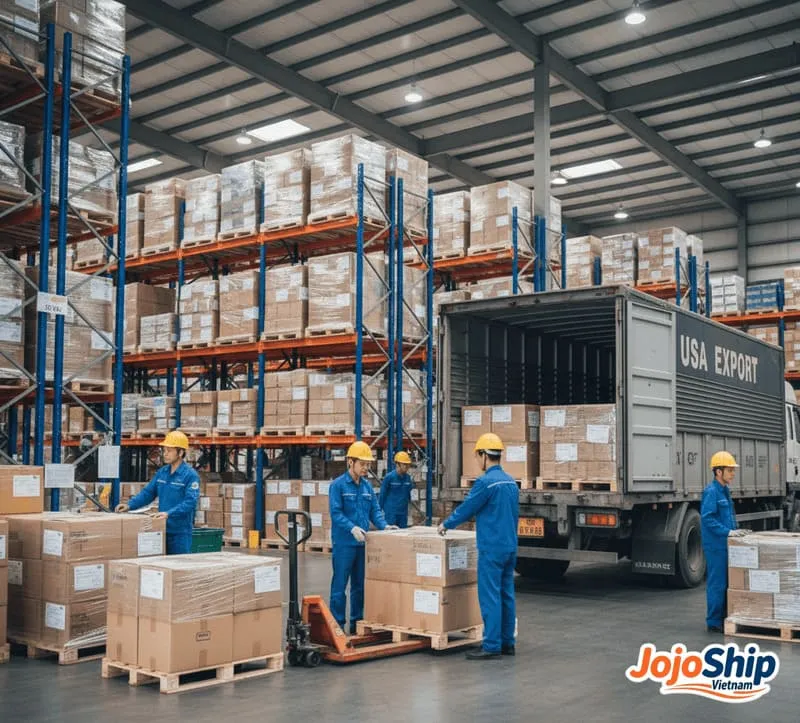
Photo: Vietnam logistics freight forwarder warehouse operations, via jojoshipping.com
For most US importers, the instinct when selecting a logistics partner in Vietnam is to default to a recognizable name. The reasoning is understandable: global carriers offer standardized processes, English-language account management, and the reassurance of institutional scale. What that logic misses, however, is that scale is not the same as capability—and in Vietnam's logistics market, the gap between the two has never been wider.
A growing cohort of mid-sized, regionally anchored freight forwarders is quietly outmaneuvering the global giants across several dimensions that matter directly to US importers: responsiveness, customs expertise, rate flexibility, and the ability to solve problems that do not appear in any standard operating procedure.
What "Local Expertise" Actually Means in Practice
The phrase "local expertise" is used so frequently in logistics marketing that it has nearly lost meaning. In Vietnam's context, however, it describes something specific and operationally significant.
Vietnam's freight environment is shaped by regulatory frameworks that change with limited advance notice, port authority relationships that influence cargo prioritization, and informal coordination networks between forwarders, customs brokers, and warehouse operators that determine whether a shipment moves on schedule or sits for days. Global carriers operate through standardized regional hubs that are often physically and organizationally distant from the facilities where these dynamics play out.
Regional forwarders, by contrast, typically have staff embedded at the port level—individuals with established working relationships with customs officials, ground handlers, and trucking operators. When a documentation discrepancy surfaces at Tan Son Nhat or when a congestion event at Cat Lai Port threatens a container's departure window, the forwarder whose team has an existing relationship with the relevant authority resolves the problem faster than one routing the issue through a regional escalation process in Singapore.
This is not a minor operational footnote. For US importers managing tight delivery windows or seasonal inventory commitments, a one-day difference in customs clearance can determine whether a shipment makes a vessel or misses it.
The Rate Flexibility Advantage
Global carriers operate with pricing structures that reflect their overhead: standardized rate cards, limited negotiating latitude for mid-sized accounts, and surcharge frameworks that apply uniformly regardless of a client's specific cargo profile or routing needs.
Mid-sized regional forwarders in Vietnam operate with meaningfully different economics. Their lower overhead, combined with direct relationships with airlines and ocean carriers rather than intermediary agreements, allows them to offer rate structures that are both more competitive and more adaptable. For an importer whose cargo profile includes a mix of hazardous materials, oversized dimensions, or irregular shipment frequencies, a regional forwarder can often construct a pricing arrangement that a global carrier's system simply cannot accommodate.
This flexibility extends to service design. A US importer requiring a hybrid arrangement—ocean freight for standard replenishment cycles, with standing air freight capacity reserved for demand surges—is a straightforward conversation with a regional provider who handles both modes directly. With a global carrier, that same arrangement may require coordination between separate business units with separate account teams and separate pricing authorities.
Customization That Scales to the Actual Problem
One of the structural limitations of large logistics organizations is that their solutions are designed for the median customer, not the specific one. Standard transit times, standard documentation packages, standard reporting formats—these serve most clients adequately and serve specific clients poorly.
Regional forwarders in Vietnam have built competitive positions precisely by serving specific clients well. A manufacturer in Binh Duong Province shipping high-sensitivity electronics to a US distribution center with narrow receiving windows has different requirements than a textile exporter in Hai Phong shipping to a West Coast consolidation hub. Regional providers design around those differences rather than asking clients to adapt to a standardized service model.
This customization extends to reporting and visibility. US importers increasingly require real-time shipment tracking, exception alerts, and documentation that integrates with their own ERP or inventory management systems. Regional forwarders who have invested in technology infrastructure—and many of the leading ones have—can often deliver more responsive visibility solutions than global carriers whose tracking platforms are built for scale rather than specificity.
What US Importers Should Evaluate
The case for considering regional forwarders is not an argument against global carriers in every situation. For importers moving extremely high volumes on standardized lanes, the infrastructure and financial stability of a global carrier may outweigh the flexibility advantages of a regional alternative. The point is that the decision should be made analytically, not reflexively.
When evaluating a regional forwarder in Vietnam, US importers should focus on four areas. First, verify the forwarder's physical presence at the specific ports and airports relevant to your supply chain—not just a headquarters address in Ho Chi Minh City. Second, assess their customs brokerage capability directly, including their track record on clearance times and their familiarity with US customs requirements, not just Vietnamese export procedures. Third, understand their carrier relationships and whether they hold actual capacity agreements or simply book through intermediaries. Fourth, request references from US-based clients with cargo profiles similar to yours.
A forwarder that performs exceptionally for garment exporters may not be the right partner for a technology importer with specialized handling requirements. The evaluation should be specific to your situation.
A Market in Transition
Vietnam's logistics sector is maturing rapidly, and the competitive landscape is shifting with it. The regional forwarders gaining ground today are not doing so by undercutting global carriers on price alone—that is a race to the bottom that benefits no one. They are winning by offering a quality of service that is genuinely difficult for large organizations to replicate: accountability, adaptability, and the kind of operational knowledge that comes only from sustained, ground-level engagement with a market.
For US importers building or refining their Vietnam supply chains, that shift represents an opportunity worth examining carefully.